
On the eve of a new decade, GITEX used its 39th edition to make a declaration: the 2020s would be built on 5G. Held from 6 to 10 October 2019 at the Dubai World Trade Centre under the banner “Synergising the Mind and Technology Economy,” GITEX Technology Week 2019 staged the region’s biggest-ever showcase of fifth-generation mobile technology — and, though nobody in the halls knew it yet, it would be the last GITEX of the old world, the final edition before the pandemic rewrote everything.
4,500 companies and the biggest 5G showcase the region had seen
The scale was the largest in the show’s history to that point: more than 4,500 exhibiting companies from over 100 countries, with more than 100,000 technology experts from over 140 countries expected through the doors across 22 halls and 1.4 million square feet. More than 180 government entities took part, 145 of them from the UAE — a measure of how completely the show had become the region’s annual parliament of technology.
But the star was 5G. The UAE’s operators had switched on their 5G networks months earlier, among the first in the world, and GITEX 2019 was where the technology showed what it was for. Etisalat presented under the theme “5G: A World Without Limits”; du, Huawei, Ericsson, Nokia and Samsung filled halls with 5G applications for transport, retail, healthcare, manufacturing, aviation and oil and gas, while the 5G Countdown conference debated the standards, security and stakes of the rollout. Samsung’s Galaxy Fold and Note 10 5G gave consumers their first hands-on with foldable, 5G-era devices.
Hyperloops, country partners and a startup surge
The 2019 edition had a gift for spectacle. Virgin Hyperloop One exhibited for the first time, showing the levitated pods it promised would one day cross the Emirates at speeds above 1,200 km/h; a new Future Mobility section gathered General Motors, Intel and Rolls-Royce around the transport of the next decade, and a GITEX Lifestyle Tech zone made its debut. Saudi Arabia stood as the show’s official country partner, represented by its smart-logistics platform Fasah — a prominent role that underlined GITEX’s standing as the whole region’s stage.
Startups surged in parallel. GITEX Future Stars brought together more than 750 startups from over 80 countries with more than 1,500 investors and corporate buyers. The conference programme ran to 290 hours, headlined by figures as varied as AI pioneer Dr Ben Goertzel of SingularityNET, Theranos whistleblower Tyler Shultz, Souq.com founder Ronaldo Mouchawar and marketing star Bozoma Saint John — a lineup that captured the show’s late-2010s character: part trade fair, part ideas festival.
📸 Follow @dxbtalk on Instagram for daily Dubai in photos →
Two operators, one race
The 5G story of 2019 had a distinctly Emirati plot: a race between the country’s two telecom giants, run in public. Etisalat anchored its presence with “5G: A World Without Limits,” bringing partners including Ericsson, Huawei and Nokia into a single showcase of what the new networks could carry. Du countered with a “5G experience corner” and zones built around uniting technology and culture, demonstrating live 5G alongside its broadband and ICT offerings. Around them, ZTE, Samsung and an army of network specialists turned the halls into a working model of the connected decade ahead — smart factories, cloud gaming, streamed-everything lifestyles.
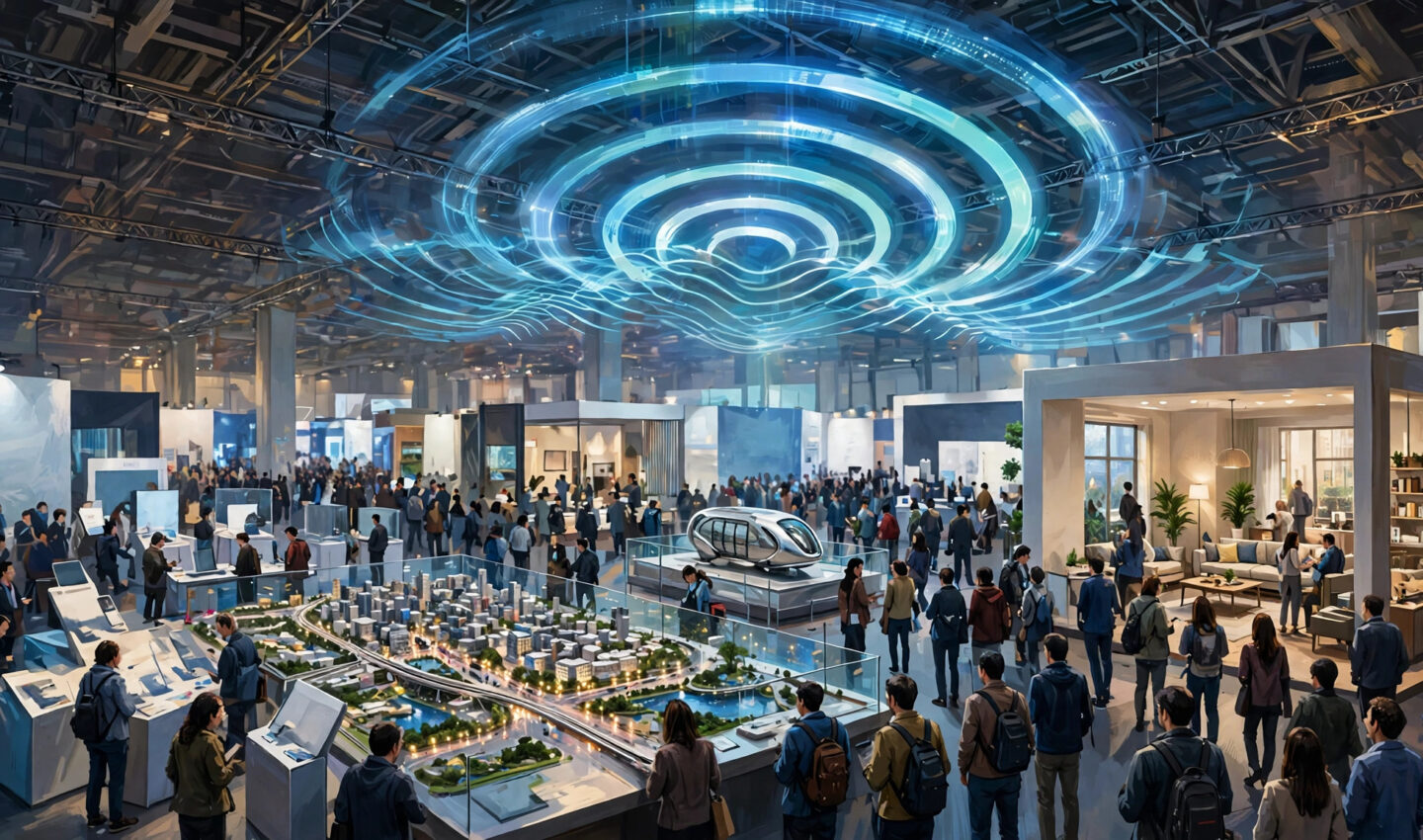
For visitors, the effect was to make an abstract spectrum race tangible. You could hold the foldable phone, ride the demos, and watch a city model light up in response to a sensor half a hall away. That tactility — try the future, don’t just hear about it — was the 2019 show at its best, and it set the expectation every later edition has had to meet.
The calm before the storm
Read today, the photographs of October 2019 — packed halls, handshakes, a hundred thousand visitors shoulder to shoulder — belong to another era. Within six months, the world’s exhibition industry would shut down entirely. Yet the themes GITEX 2019 bet on proved prophetic: 5G became the region’s connective tissue, the startups of Future Stars matured into the ecosystem that now fills Expand North Star, and the government presence that filled those 22 halls became the backbone of the AI-era editions to come.
Future Stars comes of age
The other coming-of-age story of 2019 played out in the startup halls. What had begun in 2016 as GITEX Future Stars, a promising corner for young companies, arrived at the 2019 edition as a major destination in its own right: more than 750 startups from over 80 countries, courted by more than 1,500 investors and corporate buyers. The energy was different from the enterprise halls — louder, younger, more speculative — and it hinted at the show’s next metamorphosis. Within three years that startup corner would be renamed, expanded and eventually given a harbour of its own as Expand North Star, one of the largest startup gatherings on the planet. The seeds of the GITEX of the 2020s were all visible in 2019, flourishing in the last autumn of the old world.
What GITEX 2019 meant for Dubai
GITEX 2019 was the high-water mark of the show’s first identity — the region’s definitive technology marketplace, at its confident pre-pandemic peak. What happened next would test it like nothing in its 38 previous years; what happened after that would make it bigger than it had ever been. Both stories begin here.
It remains, for many long-time exhibitors, the edition against which all others are affectionately measured.
Continue through the archive in our history of GITEX, from the first Gulf Computer Exhibition of 1981 to the AI era.
Part of the DXB Talk GITEX archive: The History of GITEX