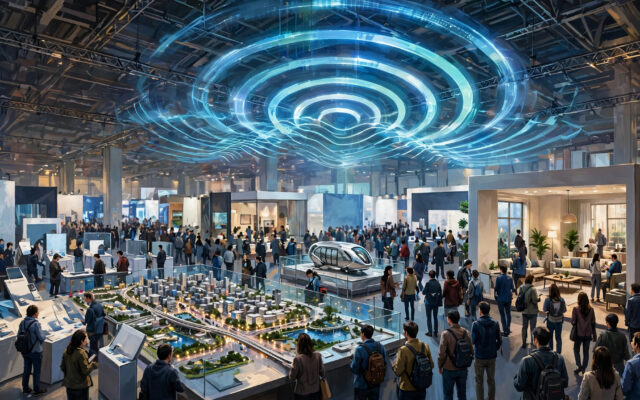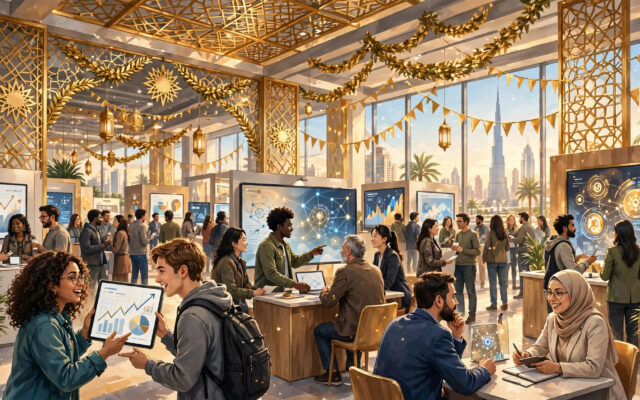

Every October for more than four decades, the world’s technology industry has beaten a path to one address in Dubai: the Dubai World Trade Centre. The show that draws it there — GITEX — began in December 1981 as a modest Gulf Computer Exhibition in a single hall, where half the visitors did not yet own a computer at work. Today, as GITEX GLOBAL, it is the largest technology event on the planet, drawing more than 200,000 visitors and nearly 7,000 exhibitors. This is the story of how a one-hall computer fair grew, decade by decade, into the world’s biggest tech show — and how Dubai grew with it.
1981: One hall, 46 exhibitors, 3,000 visitors
GITEX was born as the Gulf Computer Exhibition, held from 15 to 19 December 1981 at the Dubai International Trade and Exhibition Centre — the complex we now know as the Dubai World Trade Centre. His Highness Sheikh Hamdan bin Rashid Al Maktoum opened the show. Inside Hall One, 46 exhibitors from countries including Austria, Canada, Japan, the Netherlands, the United Kingdom, the United States and West Germany showed the region its first close-up look at the computer age: Arabic-language software, British Telecom’s Prestel information service, and the ICL Perq, one of the first personal workstations with a graphical interface. Around 3,000 visitors from across the Gulf attended — at a time when, as the Dubai World Trade Centre later recalled, half of them did not even have a computer at work.
The timing mattered. Dubai had just completed the Trade Centre tower, then the tallest building in the Gulf, and was positioning itself as the region’s trading crossroads. A computer exhibition was a statement of intent: the future would be traded here too.
The 1980s: A name is born
The show grew quickly with its venue. In 1982 it expanded into a second hall with more than 70 exhibitors from 14 countries. In 1988 came the moment that fixed its identity: with the launch of MacWorld at the show, the Gulf Computer Exhibition was renamed the Gulf Information Technology Exhibition — GITEX. That year’s edition set new records with 7,500 visitors and 80 exhibitors representing 180 companies, and a year later attendance passed 10,000. The personal computer was arriving in Gulf offices, and GITEX was where the region came to buy it.
📸 Follow @dxbtalk on Instagram for daily Dubai in photos →
The 1990s and 2000s: The region’s technology marketplace
Through the 1990s GITEX became the launchpad for the products that defined the digital era in the Middle East. In 1995 it hosted the regional launch of Windows 95, the operating system that put a graphical interface on every desk. The show filled more and more of the Trade Centre as Dubai’s own ambitions widened — free zones, an internet city, a government determined to move its services online.
By its 25th anniversary in 2005, GITEX was drawing 125,000 visitors. In 2009, Microsoft unveiled Windows 7 to a crowd reported at more than 150,000 people — a sign of how central the Dubai show had become to the global industry’s calendar. By 2010, GITEX was recognised as the third-largest ICT show in the world, behind only CeBIT and CES in the industry’s pecking order of the time.
The 2010s: From trade fair to tech festival
The smartphone decade changed what GITEX was. No longer just a place to source hardware, it became a festival of ideas — smart cities, artificial intelligence, blockchain, fintech and future mobility — with governments as prominent as vendors. Smart Dubai used the show each year to unveil the emirate’s newest digital services, and the world’s technology giants built ever larger pavilions.
In 2016 the show planted the seed of its next evolution with GITEX Future Stars, a dedicated startup event that recognised where the industry’s energy was moving. By 2019, the 39th edition — themed “Synergising the Mind and Technology Economy” — fielded more than 4,500 companies and the region’s biggest-ever 5G showcase, with Saudi Arabia as official country partner and Virgin Hyperloop One pods gleaming in the mobility hall.
Then came the test. In December 2020, with the world’s events industry shut down, GITEX Technology Week went ahead at the Trade Centre as the only live, in-person global technology event held anywhere that year — 1,200 exhibitors under strict safety protocols. It was a declaration that Dubai intended to lead the events world’s recovery, and the industry noticed.
2021–2022: The comeback and the rebrand
The 2021 edition, staged as GITEX GLOBAL x Ai Everything in the UAE’s Golden Jubilee year, brought more than 3,500 exhibitors from over 140 countries back to Dubai and launched new institutions including Fintech Surge and the GITEX GLOBAL Leaders’ Vision summit. Then, in 2022, the show took the name it had earned: GITEX GLOBAL. Across 26 halls and two million square feet, more than 5,000 companies met 138,000 visitors; the metaverse took centre stage in the X-VERSE experience, coders gathered at the first Global DevSlam, and a two-seat flying car made its first public flight during show week. GITEX was no longer a regional fair with global guests. It was a global platform that happened to live in Dubai.
2023–2025: The AI era, at full scale
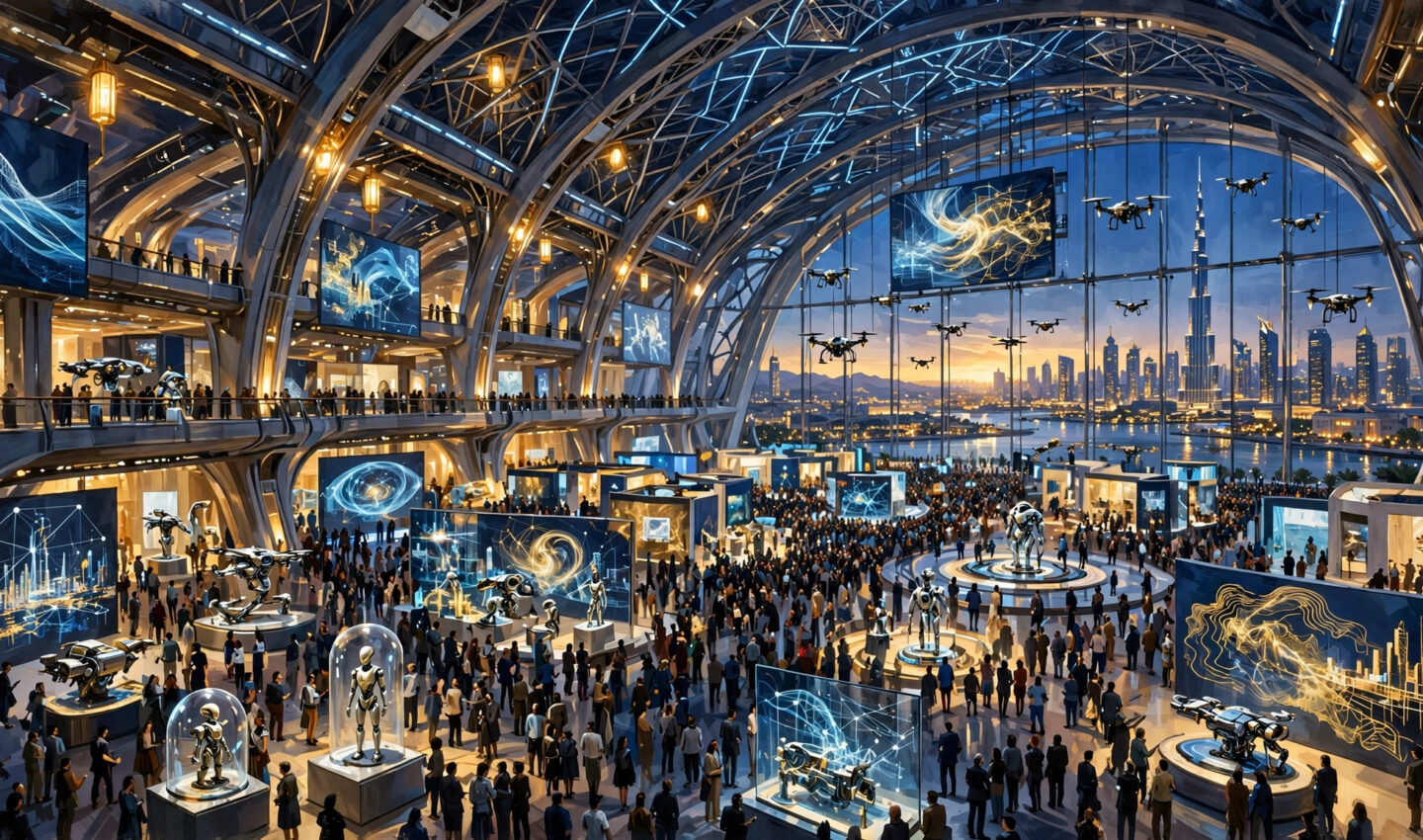
If 2022 was about going global, 2023 was the year artificial intelligence swallowed the show whole. Opened by His Highness Sheikh Mohammed bin Rashid Al Maktoum, the 43rd edition hosted 6,000 exhibitors and 180,000 executives from 180 countries across two venues, with the startup show — renamed Expand North Star — taking over Dubai Harbour. Abu Dhabi’s Technology Innovation Institute showed off Falcon 180B, then the world’s most powerful open-source AI model, under the same roof as Microsoft, Huawei, Google and Salesforce.
The brand itself began to travel. GITEX Africa debuted in Marrakech in May 2023, independently rated the world’s best tech-event launch; GITEX Europe followed in Berlin in May 2025 and GITEX Asia in Singapore in April 2025. In Dubai, the 2024 edition — themed “Global Collaboration to Forge a Future AI Economy” — drew 6,500 exhibitors and some 200,000 visitors, with flying cars overhead and billion-dollar cloud deals signed on the floor. The 45th edition in October 2025 was the largest yet: 6,800 exhibitors, 2,000 startups, 1,200 investors and delegations from 180 nations.
And then, at the close of that record edition, came the announcement that ends this chapter: GITEX had outgrown its birthplace.
The show that grew up with its city
It is impossible to separate GITEX’s story from Dubai’s. The exhibition was founded in 1981, the same era that gave the emirate its great port and its Trade Centre tower, when the city’s bet was that geography plus ambition could make it the Gulf’s marketplace. Each decade of the show mirrors a decade of the city. The computer fair of the 1980s served a trading town computerising its offices. The Windows-era marketplace of the 1990s served a regional hub wiring itself for the internet age. The smart-government showcases of the 2010s served a city-state determined to digitise itself first and sell the expertise second. And the AI summits of the 2020s serve an economy racing to diversify beyond hydrocarbons into knowledge, capital and code.
That symbiosis explains GITEX’s peculiar character among the world’s tech shows. CES belongs to an industry; GITEX belongs to a city that uses it — as a shop window for national projects, a negotiating table for sovereign ambitions, and an annual proof, delivered in person to hundreds of thousands of witnesses, that the future is being built here. The exhibitors change with every technology cycle. The host’s strategy never has.
It also explains the loyalty the show inspires. Exhibitors describe a particular feeling in the Trade Centre halls in October — part trade fair, part state occasion — that no convention centre elsewhere quite reproduces. Governments do not merely attend GITEX; they perform at it, unveiling the services and strategies by which they intend to be judged. Companies do not merely exhibit; they announce, knowing the world’s technology press corps is assembled in one city for one week. And visitors do not merely browse; they witness a city auditioning, annually and successfully, for the future.
GITEX leaves home: Africa, Europe, Asia
The surest sign of GITEX’s maturity is that Dubai began exporting it. In May 2023, GITEX Africa opened in Marrakech, Morocco — the brand’s first edition outside the Emirates, inaugurated by Moroccan Prime Minister Aziz Akhannouch and attended by leaders including the Secretary-General of the International Telecommunication Union. It drew thousands of attendees from more than 100 countries and was independently rated the world’s best technology-event launch, a remarkable verdict for a first attempt. Before that year was out, standing in the halls of the Dubai edition, the organisers announced the next frontier: GITEX Europe, to debut in Berlin in May 2025 in partnership with Messe Berlin, taking the model into the heart of the world’s largest single market.
Asia followed. Announced during the 2024 Dubai edition, GITEX Asia opened at Marina Bay Sands, Singapore, in April 2025 with more than 400 speakers and participants from 110 countries, covering artificial intelligence, cybersecurity, quantum, health technology and digital economies. A fair that began as a service to Gulf computer buyers had become a network of intercontinental platforms — each one flying talent, capital and attention back to the mothership in Dubai each autumn, and each one proof that the GITEX formula travels.
2026: A new home at Expo City
From 7 to 11 December 2026, GITEX GLOBAL moves to the Dubai Exhibition Centre at Expo City Dubai — the legacy site of Expo 2020 — reimagined as “GITEX 5.0,” the world’s first “TechCation,” with a summit day at the Trade Centre on 7 December and the expo running 8–11 December in its new home. After 45 editions, the show returns to December, the month where it all began in 1981 — but at a scale its founders could scarcely have imagined: one hall and 46 exhibitors has become a city-scale festival of the world’s technology, and a small Gulf computer fair has become the biggest tech show on Earth.
The story in numbers
Statistics rarely stir the blood, but GITEX’s do, because they trace a city’s rise. In 1981: 46 exhibitors, 3,000 visitors, one hall. In 1988, the year of the GITEX name: 7,500 visitors. In 2005, the silver jubilee: 125,000 visitors. In 2009, a single product launch — Windows 7 — performed before a crowd reported at 150,019. In 2022, the first GITEX GLOBAL: 5,000 companies, 138,000 visitors from 170 countries, two million square feet. In 2023: 6,000 exhibitors and 180,000 executives from 180 countries across two city venues. In 2025: 6,800 exhibitors, 2,000 startups, 1,200 investors, and more than 200,000 attendees — the largest technology gathering on Earth. Forty-five editions, one direction of travel.
What never changed is the idea underneath. Dubai built GITEX the way it built its ports and its skyline: start with a hall, invite the world, and keep expanding until the world has no choice but to come. For the full story of each era, explore our year-by-year archive below — and for dates, tickets and the new venue, read our complete guide to GITEX GLOBAL 2026.