
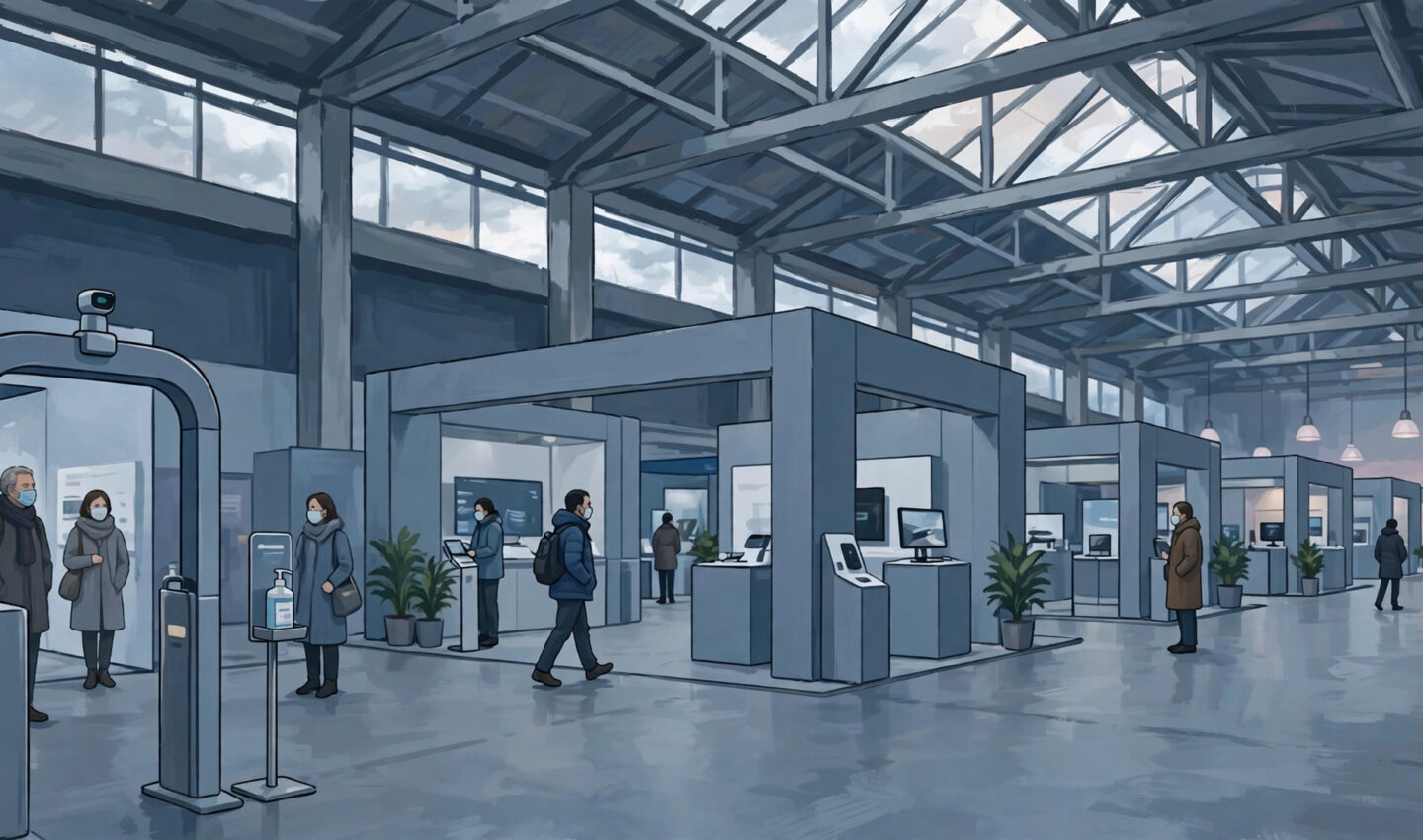
In 2020, the global events industry went dark. Conferences were cancelled on every continent; the great tech shows of America, Europe and Asia either shrank into webinars or vanished from the calendar entirely. Every one, that is, except one. From 6 to 10 December 2020, the 40th edition of GITEX Technology Week opened its doors at the Dubai World Trade Centre — the only major live, in-person technology event held anywhere in the world that year. This is the story of the show that refused to go virtual.
A decision that made headlines around the world
The decision to proceed was itself the headline. His Highness Sheikh Hamdan bin Mohammed bin Rashid Al Maktoum, Crown Prince of Dubai, opened the show; His Highness Sheikh Mohammed bin Rashid Al Maktoum, who toured the halls during the week, framed it as a statement of intent: the exhibitors from 60 countries who had come to Dubai, he said, had placed their trust in the city, and organising GITEX as an in-person event “reflects our determination to overcome the current circumstances.”
More than 1,200 innovative technology enterprises, startups and government entities took part, alongside over 200 of the world’s most active investors and venture capitalists from 30 countries, and a programme of more than 350 speakers. In a normal year those numbers would have been modest by GITEX standards. In December 2020, they were extraordinary.
How do you stage a tech show in a pandemic?
Carefully, was the answer. GITEX 2020 ran under strict precautionary protocols: admission was by advance online registration only, with no on-site registration, ticket sales or badge issuance; capacity, movement and gatherings were managed to health-authority standards. The choreography was itself a technology story — the event became a working demonstration of how large gatherings could resume safely, watched closely by an events industry desperate for a template.
Under the GITEX umbrella sat the region’s leading specialist shows: GITEX Future Stars, the region’s largest startup event; GISEC, its flagship cybersecurity conference; the Future Blockchain Summit; and the inaugural edition of Marketing Mania, a new platform for brand marketers. The content spanned artificial intelligence, 5G, future mobility, security and blockchain — the full post-pandemic agenda, debated in person by people who had spent the year on video calls.
A new chapter in the region’s story
GITEX 2020 also carried a significance beyond technology. Staged just months after the Abraham Accords, it welcomed the UAE’s first major Israeli business delegation to a global trade event — a moment widely noted as the new relationship made visible, in business dress, on an exhibition floor. In a week designed to project recovery, it doubled as an emblem of a region redrawing its map.
There was poetry in the calendar, too. The very first Gulf Computer Exhibition had opened in December 1981. Thirty-nine years later, the 40th edition returned to December — smaller, masked, distanced, but unmistakably alive.
📸 Follow @dxbtalk on Instagram for daily Dubai in photos →
A template the whole industry studied
The operational legacy of GITEX 2020 travelled far beyond Dubai. Event organisers on every continent studied how the show had been run — the advance-registration-only model, the managed capacities, the choreography of a large professional gathering under health rules — because it was, for most of that year, the only working example in the world. Dubai’s authorities and DWTC had effectively published a proof of concept: with discipline and technology, the business of meeting could continue.
Inside the halls, the programme carried the same practical spirit. Rather than futuristic escapism, the conversation of that December week centred on resilience: remote work, digital government, health technology, cybersecurity for a suddenly distributed workforce, and the 5G networks that had carried communities through lockdown. The technology industry had spent 2020 keeping the world running from spare rooms; at GITEX, it finally met to take stock — in the flesh.
A smaller show, a larger meaning
Judged by the standards GITEX would set a few years later — six thousand exhibitors, two hundred thousand visitors — the 2020 edition was modest. Judged by its moment, it was monumental. Every exhibitor who flew in, every speaker who took a stage, every investor who walked those quiet halls was voting, in person, for the proposition that the world’s business could continue. Trade press around the globe covered the show precisely because it was singular: the one place on Earth where the technology industry still gathered. In the long history of GITEX, no edition better deserves the word “defining” — the year the show proved it was not a fair-weather institution but part of the city’s operating system.
What GITEX 2020 meant for Dubai
Other cities hosted virtual summits in 2020. Dubai hosted the real thing, and the industry’s memory of that fact proved durable: when the world’s event organisers and technology companies planned their return to live business, Dubai was the proven venue. GITEX 2020 was less an exhibition than an argument — that the future belongs to places willing to show up for it. The full-throated comeback of 2021, and the record editions that followed, were built on the trust earned in this quiet, determined week.
There is a final detail worth recording. The 2020 edition closed on 10 December — five days short of the 39th anniversary of the first Gulf Computer Exhibition’s opening day in 1981. A show that had survived the region’s wars, oil shocks and financial crises had now survived a pandemic, in person, when no comparable event on Earth had managed it. Whatever came next for GITEX, its place in Dubai’s story was secure.
Read the complete journey in our history of GITEX, from one hall in 1981 to the world’s biggest tech show.
Part of the DXB Talk GITEX archive: The History of GITEX