Every Dubai resident has driven past it a thousand times: a slim, elegant tower rising from a roundabout in Deira, topped by four clock faces. The Deira Clocktower, built in the early 1960s, is one of the oldest landmarks in a city that tends to demolish and rebuild — and one of the few structures that connects modern Dubai to the small trading port it used to be. You cannot climb it, and there is no visitor centre, but it makes a rewarding short stop if you know the story behind it.
The Story of the Clocktower
The tower was built around 1963–1965, in the first years of Dubai’s modern development under Sheikh Rashid bin Saeed Al Maktoum. The story most often told is that the clock itself was a gift, and that the tower was constructed to house it at what was then the gateway to the city — the point where the road from the airport and Sharjah met the Creek-side town. For travellers arriving in the Dubai of that era, the Clocktower was among the first landmarks they saw.
Look at old photographs and the design makes sense: a slender concrete structure with the clock held high in a distinctive frame, sometimes described as having an oil-derrick-like quality — fitting for a town on the edge of an oil boom. The roundabout it stands on was long known simply as Clocktower Roundabout, and the name survives in how residents give directions today, even though the road layout around it has been rebuilt more than once.
Why It Matters
Dubai’s famous buildings are mostly young. The Clocktower belongs to the small club of structures — along with the Al Fahidi fort (now Dubai Museum’s home), the Sheikh Saeed Al Maktoum House and the early Creek-side buildings — that predate the skyscraper era. It marks the moment Dubai began building for a motor age: a proper gateway monument for a town whose main road junction needed a clock everyone could navigate by.
It has also been renovated and restored rather than replaced, which says something about its place in the city’s memory. Generations of residents — especially in Deira — have used it as a meeting point and a directional anchor: “near the Clocktower” is a complete address in old Dubai.
How to Visit
The Clocktower stands on a traffic island near the Deira end of Al Maktoum Bridge, close to the Baniyas Road and Al Rasheed Road area. Because it sits within a busy road junction, visiting means viewing it from the surrounding pavements and vantage points rather than walking up to its base — plan it as a viewpoint stop, not a site you enter.
- Getting there: the nearest metro stations are on the Deira side of the Green Line — Al Ras, Baniyas Square and Union are all within a walk or a short taxi hop. Driving, expect the junction to be busy at peak hours; nearby parking is in the surrounding Deira streets and buildings.
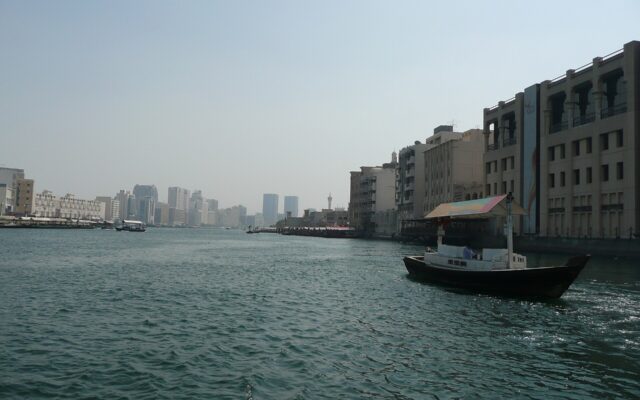
- Best viewpoint: the pavements along Baniyas Road and the Creek side give the classic postcard angle — the tower with the Creek and dhows nearby. Early morning and the hour before sunset give the kindest light for photographs.
- How long: fifteen to thirty minutes is plenty for the tower itself. Its real value is as the anchor of a Deira walk.
Build It Into a Deira Walk
The Clocktower makes most sense as one stop on an old-Dubai route:
- Start at the Gold Souk and Spice Souk in Al Ras — a short distance away.
- Walk the Baniyas Road dhow wharves, where traditional boats still load cargo.
- Pause at the Clocktower for the story and the photographs.
- Cross the Creek by abra to Al Fahidi Historical Neighbourhood and Dubai Museum on the Bur Dubai side.
Done this way, the tower stops being a roundabout you drive around and becomes what it was built to be: the gateway marker between the airport road and the old trading town.
The Clocktower in Old Photographs
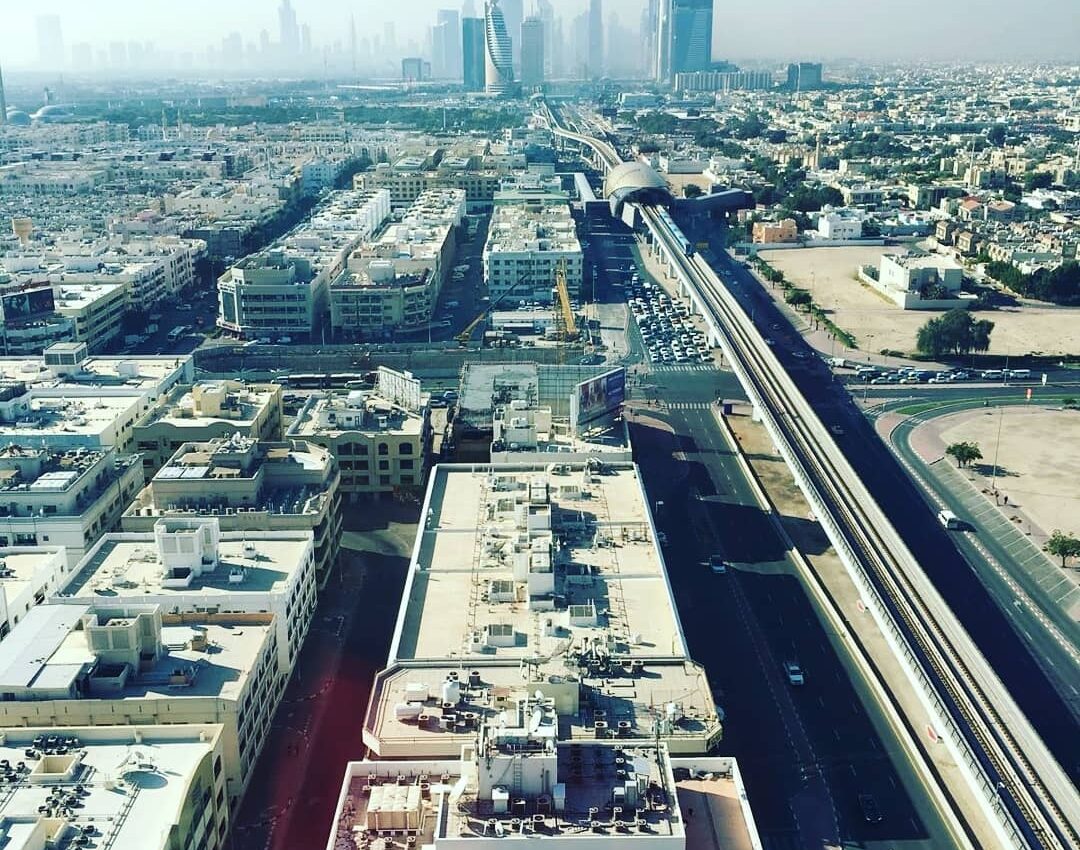
If the tower sparks your interest, hunt down photographs of Deira from the 1960s and 1970s — they are widely reproduced in heritage displays, including at Dubai Museum and the Etihad Museum. The comparison is startling: the Clocktower rises from near-empty ground at the edge of a small town of low buildings, the most prominent vertical landmark for miles. Within a generation, the same junction sat in the middle of a dense, high-rise city. Few single viewpoints in Dubai compress the emirate’s transformation into one frame the way the Clocktower does, which is why photographers and film-makers keep returning to it whenever they need to say “old Dubai” in a single image.
Quick Facts to Know
- Built in the early 1960s, in the Sheikh Rashid era of Dubai’s first modern expansion
- Stands at the historic gateway junction near Al Maktoum Bridge, Deira side
- Four clock faces, visible to traffic approaching from all directions
- Viewed from outside only — there is no public entry or tour
- Pairs naturally with the Deira souks, the dhow wharves and an abra crossing
In a city that measures landmarks in superlatives, the Deira Clocktower’s claim is different: it has simply been there, keeping time, since before almost everything else. That alone makes it worth a stop — ideally on foot, at golden hour, with the Creek on one side and six decades of Dubai history standing quietly on the other.