Ask ten Dubai residents about a weekend in Palm Jumeirah and you will get ten confident answers, at least four of which are out of date. This guide sticks to how things work now: the systems involved, the steps in their real order, and the details that decide whether it goes smoothly or becomes a story you tell at dinner.
Mistakes residents make (so you don’t have to)
The recurring mistakes are boringly consistent. Acting on a friend’s experience from three years ago in a system that has since moved online. Paying an intermediary for something the official app does free. Signing — a lease, a contract, a package — before reading the clause that governs leaving it. And assuming that because something is common practice it is therefore permitted: Dubai tolerates a lot informally right up to the moment it doesn’t.
The antidote is unglamorous: verify on the official channel, read the document, ask what happens if you need to stop or leave, and get commitments in writing. None of this slows a well-run process by more than a day, and it prevents the month-long unravellings that fill the community forums.
A realistic timeline
Set expectations in weeks, not days. The straightforward version of this process, with documents ready, typically completes in a few working days of actual processing spread across one to three weeks of appointments, approvals and deliveries. The complicated version — a document to attest, a record to correct, a counter that needs a second visit — doubles that, and it is still normal.
The timeline you control is your own preparation: documents gathered, forms understood, fees budgeted, appointments booked at the calm end of the day. Residents who prepare experience Dubai’s systems as impressively efficient; residents who improvise experience the same systems as a maze. The difference is rarely the system.
📸 Follow @dxbtalkofficial on Instagram for daily Dubai in photos →
The two-day shape
Day two, morning: one headline sight (Burj Khalifa/Downtown, the Creek and souks, or the Palm/Marina axis — pick one, not all three) done early before crowds and heat. Afternoon: rest, pool or mall air-conditioning. Evening: the dinner you have been saving, ideally in a district with a view or a story, then a walk. Day three, if you have it, belongs to Palm Jumeirah again — brunch, the local park or beach side, and the airport run timed generously.
What guests remember is rarely the tallest building; it is the cafeteria breakfast, the abra ride, the sunset from your district’s edge. Build the plan around two or three such moments and let the rest be easy. Keep taxis and Careem as the default for guests — first-time metro navigation with luggage and jet lag is a false economy.
Hosting visitors in Palm Jumeirah
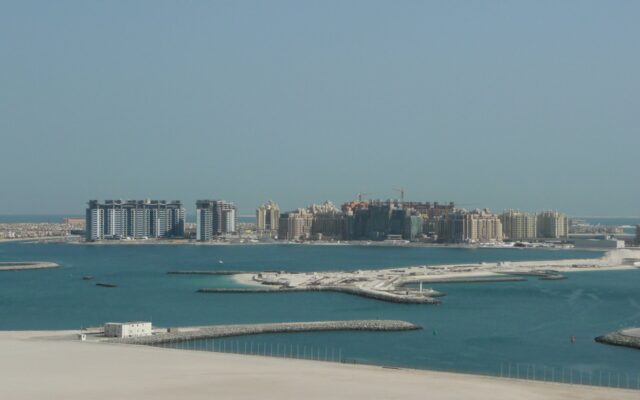
Guests staying with you in Palm Jumeirah need a plan that mixes the postcard city with your real district — too much of either disappoints. Day one stays local: settle them in, a walk around Palm Jumeirah — the palm-shaped island of luxury villas, resort hotels and apartment towers off the Marina coast — the community shop for supplies, and an early night if they have flown far. Save the big-ticket Dubai for day two, when they have their bearings and the jet lag has a shape.
Brief them on the practicalities on arrival: the weekend rhythm (Friday-Saturday), prayer-time pauses in some services, photography etiquette, dress expectations in malls and old districts, and the heat rules for the season you are in. Ten minutes of briefing saves a weekend of friction.
The seasonal angle
Almost everything in Dubai has a season. Summer compresses life indoors and slows some official processes as people travel; the winter months crowd the diaries, the roads and the appointment systems; Ramadan reshapes working hours and the rhythm of the day itself. Where timing is yours to choose, choose deliberately: the same task can be a calm errand in one month and a campaign in another, purely because of when the whole city is trying to do it too.
Common questions
Can I do most of this online?
Mostly, yes — Dubai has moved the majority of resident transactions into official apps and portals. The steps that still need your presence are usually biometrics, medicals, signatures and original-document sighting. Start online, and attend in person only for the step that requires your body.
Where do residents get reliable local detail?
Community groups for your district, school or workplace hold the lived detail — which branch is quick, what the process felt like last month. Combine that texture with the official source for the rule itself, and you have the full picture.
What is the most common mistake?
Acting on out-of-date advice. Systems here change yearly; a friend’s experience from a previous contract or a previous visa is a starting point, not a rule. The second most common mistake is paying an intermediary for a step the official app handles directly.
Where do residents get reliable local detail?
Community groups for your district, school or workplace hold the lived detail — which branch is quick, what the process felt like last month. Combine that texture with the official source for the rule itself, and you have the full picture.
The bottom line
The pattern underneath a weekend in Palm Jumeirah is the pattern underneath most of Dubai life: the systems work, the paperwork is the price, and preparation is the discount. Do it once, properly, and you join the residents who find this city easy. More step-by-step resident guides live at dxbtalk.com.